Our final 2022-23 concert set, an interview with cellist and co-Artistic Director Jennifer Morsches, the arrival of spring, and more!


We wish each and every one of you a happy, healthy and peaceful 2023. And a very special thank you for your exceptional end-of-year giving! We surpassed totals from years in the past, and feel there is much to celebrate as we continue our dual mission of public concerts and work with marginalized youth this coming year.

We are excited to start the new year in 2023 with a special program dedicated to Baroque sacred and secular music that was inspired by the veneration of the Madonna. Including Corelli’s famous “Christmas Concerto” for strings and continuo, we are showcasing vocal works by Isabella Leonarda, Georg Friedrich Händel and Giovanni Battista Ferrandini. In 17th-century Italy, convents were beehives of musical activity, a pursuit of which women could dedicate themselves fully and without prejudice. The nun Leonarda thrived in this setting, becoming one of the most prolific composers of her era, writing and publishing over 200 works. The riches of the musical circles the young Georg Friedrich Händel encountered when he lived in the Papal state of Rome, helped develop his own personal writing style that enabled him to stand apart from his peers, especially in his vocal output (both sacred and operatic). On our program we will perform two Marian cantatas (one mistakenly attributed to Händel), as well as instrumental music from another north German musician, Johann Rosenmüller, also inspired by the ornamental elements of the Italian Baroque that honored the Virgin Mary. We are delighted to have Meg Bragle join us for this program. Widely praised for her musical intelligence and “expressive virtuosity” (San Francisco Chronicle), Meg has earned an international reputation as one of today’s most gifted mezzo-sopranos, particularly in the field of early music.
Please note the different Cambridge venue* and start times!**
Friday, January 13th, 2023 at 7pm at Brattleboro Music Center, Brattleboro VT (tickets at bmcvt.org)
Saturday, January 14th, 2023 at 8pm** at Pickman Hall, Longy School of Music* in Cambridge
Sunday, January 15th, 2023 at 7pm** at Follen Community Church in Lexington

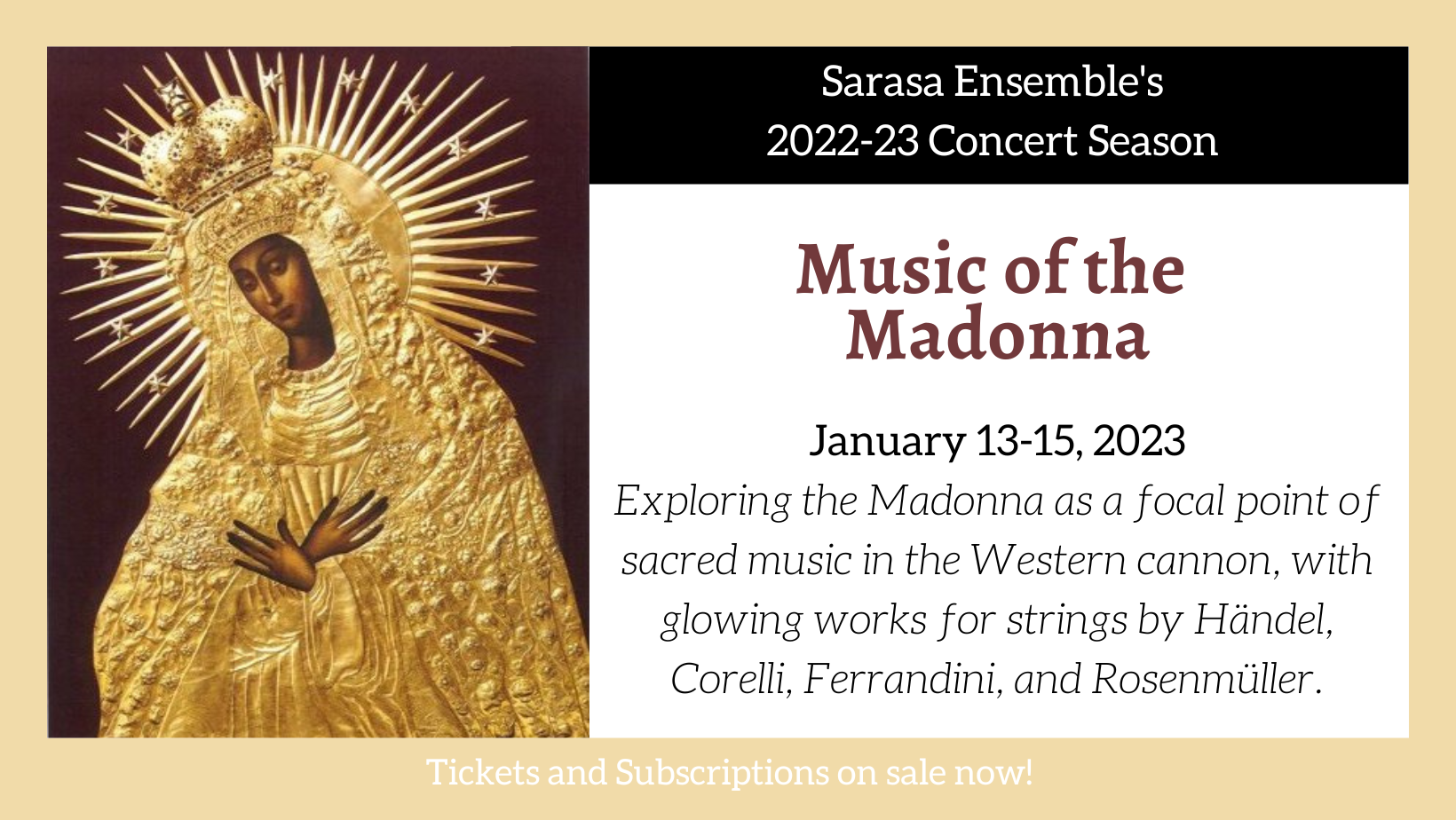
The image we have chosen for this program is the Virgin of Ostra Brama, located in a chapel tower found along the old city walls of Lithuania’s capital, Vilnius. Her image was mounted at the Gate of Dawn in 1620 by the Carmelites as extra protection for the city "from on high.” When in 1655 a Russian army set fire to the city, a fire which lasted 17 days, this icon of the Virgin miraculously survived. She became a symbol of hope and deliverance for both the Lithuanian and Polish peoples who co-existed there. She survived another fire when the chapel burned down in 1715 because a young monk saved her from the flames. Much later, during World War II, the Vilna people felt their sacred Mother should be hidden from the German troops, but the Archbishop argued their black Madonna should remain as a symbol of hope and survival against aggression and oppression.

She was considered the greatest intercessor with God and Christ at a time when the fear of Purgatory loomed large in the Christian psyche. Prayers and devotions seeking the Virgin Mary's aid were among the most significant aspects of spiritual life in communities. The texts of these prayers were set to music for devotional use. Over 500 years ago, Josquin des Préz, created his ground-breaking homage to the Virgin Mary in his most famous motet, ’Ave Maria, Virgo serena.’ Its text has continued to inspire composers over the course of music history.
Ave Maria Josquin des Préz - 1485
Ave Maria Schubert - 1825 (Barbara Bonney, soprano)
Ave Maria Bach-Gounod - 1853 (Maria Callas, soprano)
Ave Maria Pawel Lukaszewski - 2017



Isabella Leonarda, Francesca Caccini, Barbara Strozzi, Antonia Bembo and Elisabeth Jacquet de la Guerre were among a number of outstanding female Baroque composers who lit the music world alight with their own compositions and performances. This program highlights some fantastic, yet neglected music by these women, who deservedly achieved a popular following usually reserved for their male counterparts. We retrace their lives and some incredible music that should be performed much more regularly!
Friday, September 16, 2022 Brattleboro Music Center, VT 7pm [tix: bmcvt.org]
Saturday, September 17, 2022 Harvard-Epworth United Methodist Church, Cambridge 7:30pm
Sunday, September 18, 2022 Follen Community Church, Lexington 3:30pm
PROGRAM:
Francesca Caccini Lasciatemi qui solo for soprano and lute Elisabeth Jacquet de La Guerre Sonata No. 2 in D major for violin, viol & basso continuo
Barbara Strozzi 'Che si può fare' from arie e voce sola, op.8 for soprano and basso continuo
Antonio Bertali Ciaconna in C major for violin and basso continuo
interval
Isabella Leonarda Sonata Duodecima for violin and basso continuo in D minor, op. 16
Elisabeth Jacquet de La Guerre Prelude from Suite No.1 in D minor Pièces de Clavecin 1er Livre
Antonia Padoani Bembo Cantata ‘Lamento della Vergine’ for soprano and continuo
With Kristen Watson, soprano; Elicia Silverstein, violin; Jennifer Morsches, piccolo cello/bass violin; Timothy Merton, cello; Michael Leopold, Baroque lute/theorbo; John McKean, harpsichord

Read our interview with Elicia Silverstein!
Co-Artistic Director Jennifer Morsches interviewed the exciting violinist Elicia Silverstein, who will be joining us for our opening concert-set. See her thoughts on the program below!
Born into an influential Florentine musical family, the composer, singer, instrumentalist and teacher Francesca Caccini's (1587-c.1640) publication Il primo libro delle musiche (1618; “The First Book of Music”) heralded a rising star in the Florentine court’s artistic/humanist circles. In performance, Caccini would have accompanied herself on the lute, at which she was highly accomplished. In her beautiful aria Lasciatemi qui solo (“Leave me here alone”), each stanza’s concluding line repeats the same words “Leave me to die,” which she most likely borrowed from the opening line of Arianna’s lament from Ottavio Rinuccini’s L’Arianna, set to music by Claudio Monteverdi in 1608.

Caccini’s gorgeous Lasciatemi qui solo:
Compare with Claudio Monteverdi's Lamento d’Arianna, SV 22:
…and the great Jeff Buckley's “Lilac Wine”
Similar to female composers, women were more often than not shunned from pursuing a scientific or artistic career. Take as one one example the remarkable 17th-century Dutch botanical artist, Maria Sibylla Merian (1647-1717). A woman of exceptional originality and a respected scholar of the natural sciences, Maria Sibylla Merian struck an unconventional figure. Breaking all the typical rules of her era, she traveled with her daughter to Surinam, the Dutch colony on the equatorial northeast coast of South America. There, she studied the flora and fauna for two years, resulting in her ground-breaking publication, Metamorphosis insectorum Surinamensium ('The transformation of the insects of Suriname’) in 1705, which brought her critical and widespread acclaim.

Passionflower with its fruit with pupae caterpillars - Maria Sibylla Merian

September is National Honey Month,
according to the Farmers Almanac! Sarasa Director Tim Merton has also been tending his bees, and will spin the honey from these honeycombs. He expects to spin around 100 pounds of honey this September.

Peekaboo!
Can you spot the beautifully camouflaged tree frog?

“Get up Leonard - it’s September!”
David Sipress, September 8, 2022 The New Yorker
Scroll to the bottom of this newsletter for information on our upcoming Labor Day sale!
Peer through the “Window of the Soul” with Sarasa, and experience a myriad number of musical personalities, such as Händel, Strozzi, Bembo, Beethoven, Brahms, Fanny Mendelssohn, Dvořák, Gershwin, and many more whose works offer inspiration and reflection during trying times.

Isabella Leonarda, Francesca Caccini, Barbara Strozzi, Antonia Bembo and Elisabeth Jacquet de la Guerre were among a number of outstanding female Baroque composers who lit the music world alight with their own compositions and performances. This program highlights some fantastic, yet neglected music by these women, who deservedly achieved a popular following usually reserved for their male counterparts. We retrace their lives and some incredible music that should be performed much more regularly!
Friday, September 16, 2022 Brattleboro Music Center, VT 7pm [tix: bmcvt.org]
Saturday, September 17, 2022 Harvard-Epworth United Methodist Church, Cambridge 7:30pm
Sunday, September 18, 2022 Follen Community Church, Lexington 3:30pm
PROGRAM:
Francesca Caccini Lasciatemi qui solo for soprano and lute Elisabeth Jacquet de La Guerre Sonata No. 2 in D major for violin, viol & basso continuo
Barbara Strozzi 'Che si può fare' from arie e voce sola, op.8 for soprano and basso continuo
Antonio Bertali Ciaconna in C major for violin and basso continuo
interval
Isabella Leonarda Sonata Duodecima for violin and basso continuo in D minor, op. 16
Elisabeth Jacquet de La Guerre Prelude from Suite No.1 in D minor Pièces de Clavecin 1er Livre
Antonia Padoani Bembo Cantata ‘Lamento della Vergine’ for soprano and continuo
With Kristen Watson, soprano; Elicia Silverstein, violin; Jennifer Morsches, piccolo cello; Timothy Merton, cello; Michael Leopold, Baroque lute/theorbo; John McKean, harpsichord

The Parliament of Women Author unknown, London, 1646.
By permission of the British Library Board. Shelfmark: E.1150(5)
The Parliament of Women. With the merrie laws by them newly enacted to live in more ease, pomp, pride and wantonnesse: but especially that they might have superiority and domineer over their husbands: with a new way found out by them to cure any or new Cuckolds, and how both parties may recover their credit and honesty againe.
We’ve heard of Hildegard of Bingen, we’ve heard of Sister Maria from “A Sound of Music.” Now we would like to introduce you to another nun with incredible musical skills, who has remained mostly ignored by both professional and student musicians, as well as scholars. Upon discovering and cataloguing her works, the 18th-century French music lover and collector, Sébastien de Brossard, wrote, "All the works of this illustrious and incomparable Isabella Leonarda are so beautiful, so gracious, so brilliant and at the same time so learned and so wise, that my great regret is not having them all.” During her many years at the convent Collegio di Sant’ Orsola in Novara, Italy, near Milan, the highly productive Leonarda wrote more than 200 works. She diverged from sacred vocal music to instrumental works at the age of 73, and is credited with being the first female composer to write violin sonatas with continuo. Here is the opening of her “Sonata duodecima” from her opus 16, which violinist Elicia Silverstein will be performing with us in September.
Isabella Leonarda (1620-1704) - Adagio from "Sonata duodecima" in D minor for violin and basso continuo

August means pickling time for many who keep vegetable gardens!
This jar of pickled peppers was inspired by Ukrainian chef, Olia Hercules. https://oliahercules.com
And for those of you with too many cucumbers, here is a great recipe for Refrigerator Pickles! YUMMY!
https://www.onceuponachef.com/recipes/quick-and-easy-dill-pickles.html





Lexington Council for the Arts

This organization is funded in part by the Massachusetts Cultural Council, a state agency.